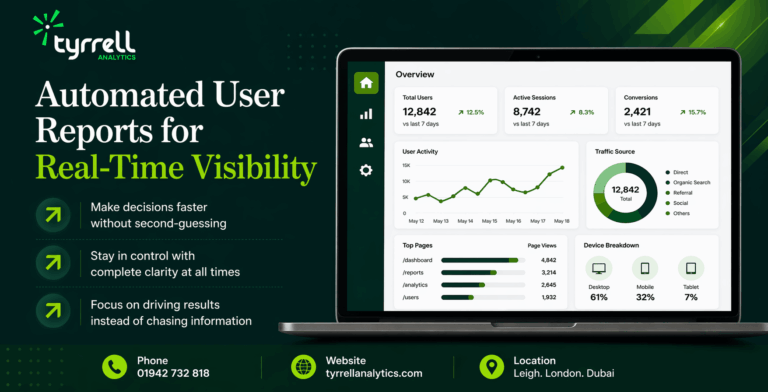
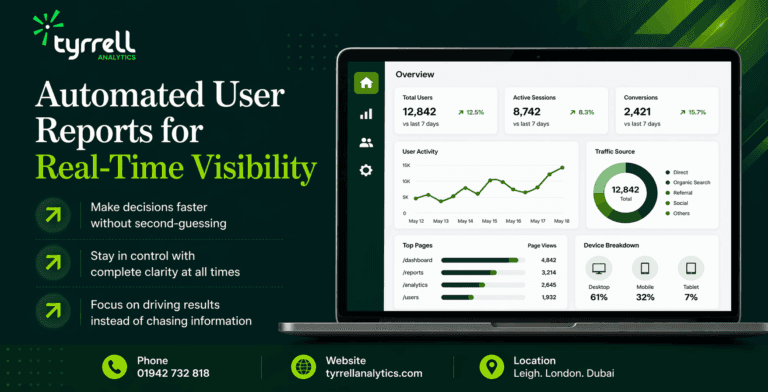
In most organisations, reporting still creates delays – and by the time a report reaches the right person, the moment to act has already passed.
Data exists, but accessing it takes time. Reports are requested, prepared, and distributed – often long after the optimal moment to act has passed.
The issue isn’t a lack of information.
It’s the gap between what’s happening and when you can see it.
Automated reporting closes that gap.
Make Decisions Without Delay
When visibility is real-time, decisions don’t have to wait.
You’re no longer relying on outdated reports or delayed updates. Instead, you can respond immediately to changes in performance, user activity, or operations.
This enables your organisation to respond with confidence – always aligned with current operational reality.
Remove the Burden of Manual Reporting
Manual reporting consumes valuable time and creates organisational bottlenecks.
Teams spend hours gathering, preparing, and validating data – time that could be spent on more valuable work.
Automated reporting removes that burden entirely, freeing your teams to focus on analysis, decisions, and outcomes – not data preparation.
Stay in Control with Continuous Visibility
Periodic reporting creates blind spots.
When visibility is limited to scheduled reports, important changes can go unnoticed. Automated reporting provides a continuous view, ensuring you always understand current performance.
This continuous awareness sharpens cross-team coordination and eliminates the uncertainty that comes with scheduled, point-in-time reporting.
Act with Confidence
Real-time data removes the hesitation that comes with uncertainty.
When your team can see exactly what is happening – right now – decisions are made faster, with greater confidence and less risk of error.
Focus on Results, Not Reporting
Reporting should support progress-not slow it down.
By removing the need to manually prepare reports, your team can focus on improving performance, identifying opportunities, and delivering results.
This shift – from managing processes to driving outcomes – is where Tyrrell Analytics delivers its greatest impact.
Conclusion
With Tyrrell Analytics, automated reporting becomes a strategic advantage – not just an operational convenience.
With Tyrrell Analytics, automated reporting becomes a strategic advantage. Your organisation can:
- Respond faster to operational changes
- Maintain continuous, uninterrupted visibility
- Eliminate time lost to manual data preparation
- Make confident, evidence-based decisions – now they matter
The result: less delay, greater control, and a team focused on what creates value.